
 Account
 Sign In
 Sign Up
Supreme Court Court Master (Shorthand) Online Form 2026 for 20 Posts
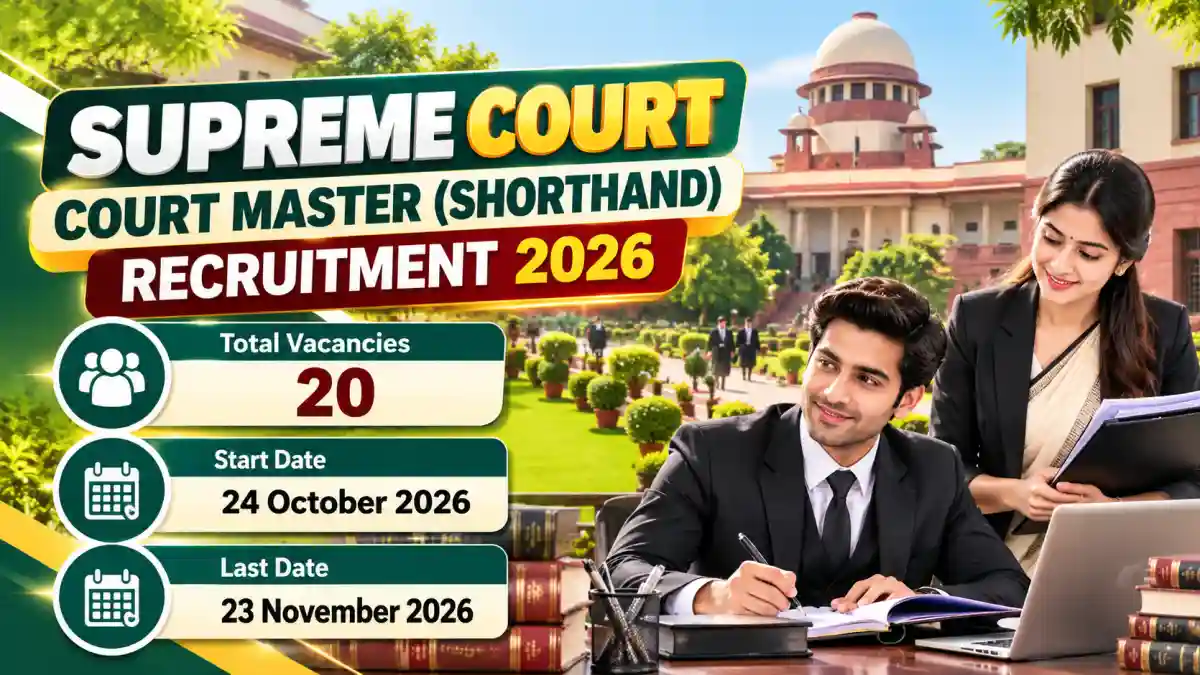
The Registry of the Supreme Court of India has released its advertisement for the Supreme Court Court Master (Shorthand) online form 2026. The Registry is preparing a panel by direct recruitment for 20 tentative vacancies of this gazetted post, which sits in Level 11 of the Pay Matrix with an initial basic pay of Rs.67,700 plus allowances.
This is not an entry-level stenographer vacancy. Applicants must already have five years of regular service in a stenographer-type cadre, hold a graduation degree and be at least 30 years old. If that describes you, the sections below explain the age rules, the four-stage selection, the fee and the small print that can get a form rejected.
Last Date: 2026-11-23 23:59:00
Quick Highlights
- Organization: Supreme Court of India (Registry)
- Advertisement No.: F.6/11/CM(S)/2026-SC (RC), dated 15 October 2026
- Post Name: Court Master (Shorthand), a gazetted post
- Vacancies: 20 (tentative, may change)
- Pay Level: Level 11, Rs.67,700 to Rs.2,08,700
- Mode of Application: Online only
- Last Date: 15 November 2026, 11.55 p.m.
Who This Recruitment Is Meant For
The advertisement invites Indian citizens who meet every condition as on 1 October 2026. The post combines an academic requirement, two skill requirements and a service requirement, so it is worth checking all four before paying the fee.
Educational Qualification and Skills
- Bachelor’s degree from a recognized university in India.
- Shorthand speed of 120 w.p.m. in English.
- Knowledge of computer operation with a typing speed of 40 w.p.m. on a computer.
Experience
Candidates need a minimum of 5 years of regular service in the cadre of Private Secretary, Senior PA, PA or Senior Stenographer in a government department, public sector undertaking or statutory body.
Age Limit
As on 1 October 2026, a candidate must not be below 30 years and the upper limit is 45 years. The relaxations work as follows:
- Usual relaxation for SC, ST, OBC (Non-Creamy Layer) and ex-Servicemen candidates, as per Government of India rules.
- Up to a maximum of five years over and above the age limit for dependants of freedom fighters.
- No upper age limit for Departmental candidates of the Registry of the Supreme Court of India.
- No relaxation for candidates working in other government departments, public sector undertakings, statutory bodies, nationalized banks and similar organizations.
Reservation
Reservation benefit is available to SC, ST and OBC (Non-Creamy Layer) candidates under Rule 4A of the Supreme Court Officers and Servants (Conditions of Service and Conduct) Rules, 1961. The notification does not give a category-wise split of the 20 vacancies. Reserved category candidates who qualify on relaxed standards can be considered only against reserved vacancies, however high their merit position.
Important Dates
| Event | Date |
|---|---|
| Advertisement issued | 15 October 2026 |
| Online registration starts | 25 October 2026 |
| Last date to submit application | 15 November 2026, 11.55 p.m. |
| Objective Type Test | 7 December 2026 (tentative) |
| Answer key upload | 8 December 2026 (tentative) |
| Objection window | 8 December to 9 December 2026, till 11.55 p.m. (tentative) |
| Shorthand Test, Typing Test and Interview | To be notified on the official website |
Application Fee
| Category | Fee |
|---|---|
| General / Unreserved | Rs.1,500 |
| SC / ST / OBC (Non-Creamy Layer) / Ex-Servicemen | Rs.750 |
Bank charges are extra. The fee is non-refundable, can be paid online only through the payment gateway provided by UCO Bank, and is not accepted in any other mode.
How the Selection Works
There are four tests, and each one has its own qualifying mark. The notification says all four stages are purely provisional until documents are verified, so a candidate who clears a test can still be dropped later if eligibility does not hold up.
| Stage | Test | Duration | Maximum Marks | Minimum Qualifying Marks |
|---|---|---|---|---|
| 1 | Objective Type Test (100 questions) | 1 and a half hours | 100 | 50 |
| 2 | Shorthand (English) Test at 120 w.p.m. | 7 minutes dictation, 45 minutes transcription | 100 | 50 |
| 3 | Typing Speed Test on Computer (English, minimum 40 w.p.m.) | 10 minutes | 20 | 10 |
| 4 | Interview | Not specified | 30 | 15 |
Objective Type Test
The 100 questions are divided as follows: 25 on General English, 25 on General Knowledge, 25 on provisions relating to the Judiciary in the Constitution of India, 15 on the Supreme Court Rules, 2013, and 10 on knowledge of computer operation. There is no negative marking. Answer keys are expected the day after the test, and an objection costs Rs.100 per objection, refunded if the objection is found valid. Objections can be sent online only, and the decision of the competent Authority is final.
Shorthand (English) Test
Mistakes up to 5 percent of the total words dictated are permitted, and a full stop mistake counts as half a mistake, as does a wrong capital or small letter. The marks depend on the share of mistakes:
| Mistakes | Marks Awarded |
|---|---|
| No mistake | 100 percent |
| Up to 1 percent | 90 percent |
| Up to 2 percent | 80 percent |
| Up to 3 percent | 70 percent |
| Up to 4 percent | 60 percent |
| Up to 5 percent | 50 percent |
Typing Speed Test and Interview
In the typing test, 2 percent mistakes of the total words typed are permitted. A wrong word or figure is a full mistake, while a wrong capital or small letter, or an omitted, added or substituted punctuation mark, is half a mistake. The interview carries 30 marks and may be held online or in physical mode in Delhi, as decided by the competent Authority.
Shortlisting Ratios
If a large number of candidates score 50 marks or more in the objective test, the merit list is used to shortlist candidates in the ratio of 1:10 against the tentative vacancies for the shorthand and typing tests. For the interview, the ratio is 1:3, and it applies to candidates who qualify in all three tests. Selected candidates are empanelled in order of merit, and a place in the panel does not give any right to appointment.
Where the Tests Will Be Held
The Objective Type Test will be held in the cities listed in Annexure A of the notification, and applicants choose cities in order of preference. The Registry can shift a candidate to another city, or even a city outside the list, for administrative reasons. The Shorthand and Typing tests will be held in Delhi/NCR only.
| State / Region | Test Cities |
|---|---|
| Delhi/NCR | Delhi/NCR |
| Uttar Pradesh | Agra, Aligarh, Bareilly, Jhansi, Kanpur, Lucknow, Meerut, Moradabad, Muzaffarnagar, Prayagraj, Varanasi |
| Bihar | Bhagalpur, Muzaffarpur, Patna |
| Jharkhand | Bokaro Steel City, Dhanbad, Ranchi |
| Odisha | Bhubaneswar/Cuttack, Dhenkanal, Rourkela |
| Assam | Guwahati |
| West Bengal | Kolkata, Siliguri |
| Uttarakhand | Dehradun, Roorkee |
| Rajasthan | Ajmer, Bikaner, Jaipur, Jodhpur, Udaipur |
| Haryana | Ambala, Kurukshetra |
| Himachal Pradesh | Hamirpur, Kangra, Shimla |
| Jammu and Kashmir | Jammu, Srinagar |
| Ladakh | Leh |
| Punjab | Amritsar, Bathinda, Ludhiana, Mohali, Pathankot, Patiala, Phagwara |
| Andhra Pradesh | Guntur, Visakhapatnam |
| Karnataka | Belagavi (Belgaum), Bengaluru, Mysuru (Mysore) |
| Telangana | Hyderabad, Warangal |
| Kerala | Ernakulam, Thiruvananthapuram |
| Tamil Nadu | Chennai, Coimbatore |
| Gujarat | Ahmedabad/Gandhinagar, Rajkot |
| Maharashtra | Chhatrapati Sambhaji Nagar, Mumbai, Nagpur, Pune |
| Chhattisgarh | Bhilai, Raipur |
| Madhya Pradesh | Bhopal, Gwalior, Indore, Jabalpur |
No request for a change of city, test centre or test date will be entertained after applying, so choose carefully.
How to Apply Online
Applications are accepted through online registration only. The link will be provided through the official website of the Supreme Court of India, and no postal application is accepted. Follow these steps:
- Check that you meet the qualification, experience and age conditions as on 1 October 2026 before you begin the form.
- Keep a recent photograph, your signature and scanned copies of your Class 10, Class 12 and graduation certificates, experience certificate and, if you are claiming reservation, your caste or community certificate ready for upload.
- Open the recruitment section of the official website of the Supreme Court of India and use the online application link provided there from 25 October 2026.
- Fill in your name, father’s name, mother’s name and date of birth exactly as they appear in your Class 10 or equivalent board certificate.
- Select your cities for the Objective Type Test in the order of your preference from the list of test centres.
- Upload your photograph, signature and documents as per the instructions on the link, then recheck every detail, because a submitted application cannot be withdrawn or modified.
- Pay the application fee online through the payment gateway, which is Rs.1,500 for General category candidates and Rs.750 for SC, ST, OBC (Non-Creamy Layer) and ex-Servicemen candidates, plus bank charges.
- Preview the completed form, take a printout for your records and note down your application number for the admit card. The printout need not be sent to the Registry.
While applying, you also have to give an undertaking that you have read and understood the terms of the advertisement and will abide by them. If any information turns out to be false, the candidature is cancelled without notice.
Rules That Catch Applicants Off Guard
- Only the last form counts. If you submit more than one application, only the one submitted last is considered.
- Name and date of birth follow the Class 10 certificate. A change in name or surname must be backed by a Gazette Notification.
- Category cannot be changed once it is filled in the online form.
- Serving government employees need an NOC. Candidates working in Central or State Government departments, nationalized banks or public sector undertakings must submit a No Objection Certificate from their employer at document verification.
- Report a new job. A candidate who is unemployed at the time of applying but gets employment during or after the examination must inform the Branch Officer, Recruitment Cell, at recruitment.cell@sci.nic.in without fail.
- Odd hours and holidays. Appointed candidates have to work at odd hours and on holidays and must give an undertaking to that effect.
- No travel allowance. No TA or DA is payable for appearing in the tests or interview.
- Admit cards are online only. They are not sent by post and must be downloaded from the website of the Supreme Court of India using the application number.
- Keep your phone and email active. Dates for the shorthand test, typing test and interview will be sent by SMS and email to the registered mobile number and email ID.
Forms that do not follow the instructions are summarily rejected. Anyone found guilty of impersonation, false documents or false information can be disqualified, prosecuted and debarred from future appointment in the Registry, even after joining.
Frequently Asked Questions
Q1. What is the Supreme Court Court Master (Shorthand) recruitment 2026?
The Registry of the Supreme Court of India is preparing a panel by direct recruitment to fill 20 tentative vacancies of Court Master (Shorthand), a gazetted post placed in Level 11 of the Pay Matrix. The number of posts may change because of administrative needs or the requirement of the Registry.
Q2. What is the last date to apply online?
Online registration starts on 25 October 2026 and the last date to submit the application is 15 November 2026 up to 11.55 p.m. The application fee also has to be paid online, so complete both before the deadline.
Q3. What is the age limit and how is it counted?
Candidates must be at least 30 years old and not more than 45 years old as on 1 October 2026. Usual relaxation is allowed for SC, ST, OBC (Non-Creamy Layer) and ex-Servicemen candidates as per Government of India rules, dependants of freedom fighters get up to five more years, and there is no upper age limit for Departmental candidates of the Registry. Candidates working in other government departments, public sector undertakings, statutory bodies or nationalized banks get no age relaxation.
Q4. Who is eligible to apply for Court Master (Shorthand)?
A candidate needs a bachelor’s degree from a recognized university in India, shorthand speed of 120 w.p.m. in English, computer typing speed of 40 w.p.m. and at least 5 years of regular service in the cadre of Private Secretary, Senior PA, PA or Senior Stenographer in a government department, public sector undertaking or statutory body. All conditions are checked as on 1 October 2026.
Q5. How much is the application fee?
The fee is Rs.1,500 for General or Unreserved category candidates and Rs.750 for SC, ST, OBC (Non-Creamy Layer) and ex-Servicemen candidates, plus bank charges. It must be paid online only through the payment gateway provided by UCO Bank and is not refundable.
Q6. What are the stages of selection?
Selection has four stages: an Objective Type Test, a Shorthand (English) Test, a Typing Speed Test on Computer and an Interview. If a large number of candidates score 50 marks or more in the objective test, candidates in the ratio of 1:10 against the vacancies are shortlisted on merit for the shorthand and typing tests, and candidates in the ratio of 1:3 who clear all three tests are called for the interview.
Q7. Is there negative marking in the objective test and when will it be held?
There is no negative marking in the Objective Type Test. The test has 100 questions to be solved in 1 and a half hours, the minimum qualifying mark is 50, and it is tentatively scheduled for 7 December 2026.
Q8. What is the salary of a Court Master (Shorthand) at the Supreme Court?
The post is placed in Level 11 of the Pay Matrix, which is Rs.67,700 to Rs.2,08,700. The initial basic pay is Rs.67,700 plus allowances as admissible under the Rules.
Source
All details in this article are taken from the official advertisement No. F.6/11/CM(S)/2026-SC (RC) dated 15 October 2026, issued by the Deputy Registrar (Recruitment), Supreme Court of India. Updates on the examination are to be published in the recruitment section of the Supreme Court website.
Disclaimer: VacancyPage is an information website and is not connected with the Supreme Court of India. The Registry may change the number of posts or the selection process without notice, so please read the official advertisement and check the official website before applying.




 Join WhatsApp