
 Account
 Sign In
 Sign Up
DSSSB District Court Recruitment 2026: 641 Posts in Five Cadres Through One Combined Exam
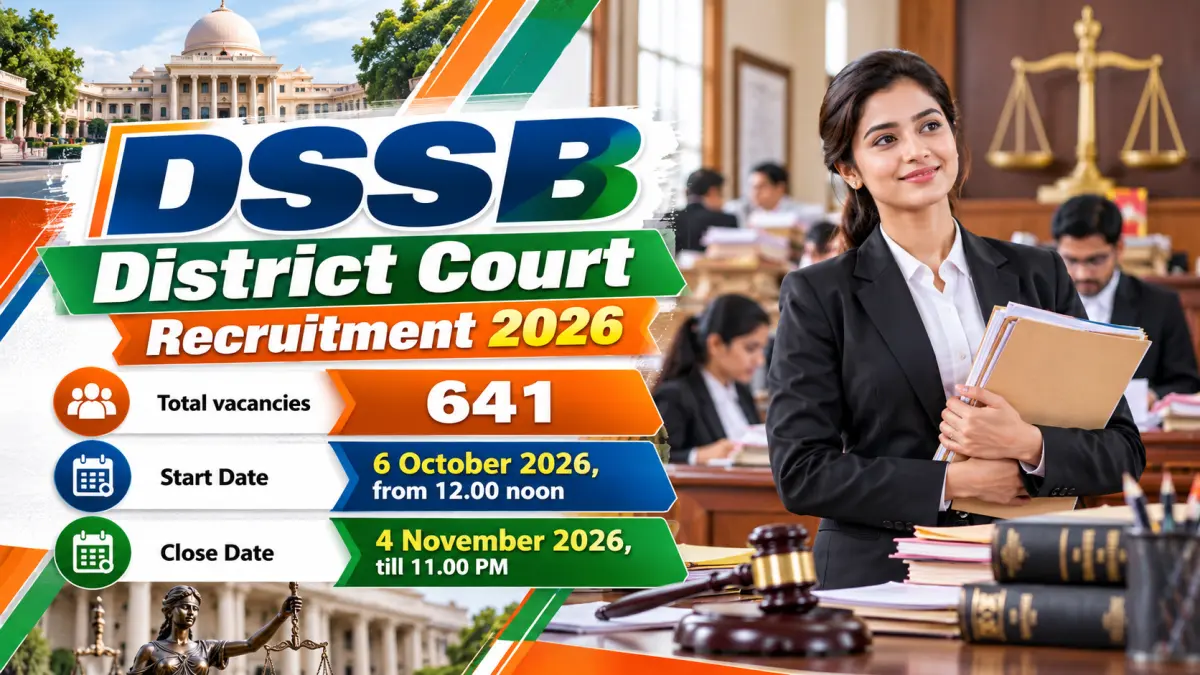
The Delhi Subordinate Services Selection Board has opened DSSSB District Court Recruitment 2026 under Advertisement No. 04/2026, dated 30 September 2026. Applications are being taken on behalf of Delhi District Courts for Senior Personal Assistant, Personal Assistant, Junior Judicial Assistant, Process Server and Peon/Orderly/Dak Peon posts, with 641 vacancies including backlog. The online window runs from 6 October to 4 November 2026, and there is no fee for women, SC, ST, PwBD and Ex-serviceman candidates.
Last Date: 2026-11-04 23:00:00
Quick Highlights
- Organization: Delhi Subordinate Services Selection Board (DSSSB), for Delhi District Courts
- Advertisement No.: 04/2026, Combined Examination, 2026
- Posts: Senior Personal Assistant, Personal Assistant, Junior Judicial Assistant, Process Server, Peon/Orderly/Dak Peon
- Total vacancies: 641 (including backlog, tentative)
- Application mode: Online only
- Last date: 4 November 2026, till 11.00 PM
- Application fee: ₹100, with exemptions for several categories
Important Dates
| Event | Date |
|---|---|
| Advertisement dated | 30 September 2026 |
| Online applications open | 6 October 2026, from 12.00 noon |
| Online applications close | 4 November 2026, till 11.00 PM |
| Cut-off date for educational qualification and certificates | 4 November 2026 |
| Date for reckoning age | 1 June 2026 |
| Exam and interview dates | Not announced yet |
The board says exam and interview dates will be intimated in due course, and only through the websites of DSSSB and the Delhi District Courts. Since messages by email and SMS are described as an additional facility, checking the DSSSB official website regularly matters more than waiting for an alert.
Vacancy Details
The 641 posts are split across four post codes. Post code 805/26 covers both Senior Personal Assistant and Personal Assistant, while Junior Judicial Assistant, Process Server and Peon/Orderly/Dak Peon carry codes 806/26, 807/26 and 808/26. Most posts are in the District and Sessions Courts, with a smaller share in the Family Courts.
| Post Code | Post | Court | Pay Level | UR | OBC | SC | ST | EWS | Total | PwBD (incl.) | ESM (incl.) |
|---|---|---|---|---|---|---|---|---|---|---|---|
| 805/26 | Senior Personal Assistant | District and Sessions Courts | 8 | 10 | 8 | 3 | 5 | 1 | 27 | 7 | Nil |
| 805/26 | Personal Assistant | District and Sessions Courts | 7 | 37 | 52 | 49 | 37 | 14 | 189 | 25 | Nil |
| 805/26 | Personal Assistant | Family Courts | 7 | 6 | 4 | 2 | 3 | 2 | 17 | 2 | Nil |
| 806/26 | Junior Judicial Assistant | District and Sessions Courts | 5 | 63 | 40 | 22 | 11 | 15 | 151 | 8 | 15 |
| 806/26 | Junior Judicial Assistant | Family Courts | 5 | 7 | 7 | 4 | 3 | 2 | 23 | 2 | 2 |
| 807/26 | Process Server | District and Sessions Courts | 4 | 38 | 25 | 13 | 6 | 9 | 91 | 4 | 10 |
| 807/26 | Process Server | Family Courts | 4 | 0 | 0 | 1 | 0 | 0 | 1 | 0 | 0 |
| 808/26 | Peon/Orderly/Dak Peon | District and Sessions Courts | 3 | 56 | 38 | 21 | 10 | 14 | 139 | 6 | 14 |
| 808/26 | Peon/Orderly/Dak Peon | Family Courts | 3 | 0 | 2 | 1 | 0 | 0 | 3 | 0 | 0 |
| Grand Total | 217 | 176 | 116 | 75 | 57 | 641 | 54 | 41 | |||
Post-wise totals work out to 233 for Senior Personal Assistant and Personal Assistant together, 174 for Junior Judicial Assistant, 92 for Process Server and 142 for Peon/Orderly/Dak Peon. The notice adds that these figures are tentative, based on what the indenting departments reported, and can go up or down by any number. Reservation rosters and the earmarking of vacancies are decided by the courts, not by DSSSB.
PwBD Suitability Differs by Post
Not every post is open to every disability category. Senior Personal Assistant and Personal Assistant are identified as suitable only for category (c), which covers locomotor disabilities such as one leg, both legs, leprosy cured, dwarfism, acid attack victims and spinal deformity or injury without associated neurological or limb dysfunction. Junior Judicial Assistant, Process Server and Peon/Orderly/Dak Peon are identified as suitable across categories (a) to (e), with the exact sub-conditions listed post by post in the notice. The suitability list comes from the user department, so PwBD candidates should read the entry for their chosen post before applying.
Qualification and Pay Scale by Post
None of the five posts asks for work experience, apart from the driving experience built into the Process Server qualification. What separates the posts is the skill requirement, and that is worth reading closely before you decide where to apply.
| Post | Essential Qualification | Pay Scale |
|---|---|---|
| Senior Personal Assistant | Graduate with shorthand speed of not less than 110 words per minute and typing speed of 40 words per minute | ₹9,300-34,800 with Grade Pay ₹4800, Group B (Non-Gazetted) |
| Personal Assistant | Graduate with shorthand speed of 100 words per minute, typing speed of 40 words per minute and knowledge of computer | ₹9,300-34,800 with Grade Pay ₹4600, Group B (Non-Gazetted) |
| Junior Judicial Assistant | Graduate with typing speed of not less than 40 words per minute on computer | ₹5,200-20,200 with Grade Pay ₹2800, Group C |
| Process Server | Matriculation pass or equivalent from a recognized board, or Higher Secondary, with a Light Motor Vehicle driving licence and 2 years of unblemished driving experience | ₹5,200-20,200 with Grade Pay ₹2400, Group C |
| Peon/Orderly/Dak Peon | Matriculation pass or equivalent from a recognized board | ₹5,200-20,200 with Grade Pay ₹2000, Group C |
The Process Server row deserves a second look. Unlike the other Group C posts, it needs a valid LMV licence and two years of clean driving experience, and the notice treats that experience as part of the essential qualification. A candidate with a matriculation certificate alone will not meet it. Educational qualification is judged as on 4 November 2026, so a degree or licence must be in hand by the closing date, not by the exam date.
Age Limit and Relaxation
Every post has the same age band: at least 18 years and below 27 years as on 1 June 2026. In date terms, a candidate must have been born on or after 2 June 1999 and on or before 1 June 2008. The date of birth on the Matriculation or Secondary School certificate is the only one accepted, and no later request to change it will be entertained.
| Category | Upper Age Relaxation |
|---|---|
| SC/ST (Group B and C) | 5 years |
| OBC (Group B and C) | 3 years |
| PwBD with UR/EWS | 10 years |
| PwBD with SC/ST | 15 years |
| PwBD with OBC | 13 years |
| Ex-Servicemen (Group B Non-Gazetted and Group C) | Period of military service plus 3 years, up to a maximum age of 55 years |
| Government employees with 3 years of regular service | No relaxation, as the DDC Rules, 2012 have no such provision |
Two points in the notice are easy to miss. First, only OBC candidates covered by the Delhi Government lists get OBC reservation and age relaxation, and OBC (Outside) candidates are treated as Unreserved and must apply under the UR category. Second, OBC candidates need a Non-Creamy Layer certificate issued on or after 1 April 2026 and no later than 4 November 2026, and EWS candidates need an Income and Asset certificate valid for the financial year 2026-2027.
Application Fee
The application fee is ₹100. Women candidates and candidates belonging to SC, ST, PwBD and Ex-serviceman categories do not pay. Ex-servicemen who already hold regular civil-side employment under the Central Government or the Government of NCT of Delhi, obtained with the help of ex-servicemen reservation, are not eligible for the concession.
Payment is accepted only through SBI e-pay. Any other mode is not considered and the amount stands forfeited, and a fee once paid is not refunded under any circumstances.
How to Apply
Applications are accepted only through the DSSSB online portal. Forms sent by post, by hand or by email are not considered, and the board will not reply to any correspondence about them. The board also suggests applying well before the closing date, because the portal can slow down or fail to log in during the last days, and DSSSB does not take responsibility for missed deadlines caused by that.
- Register on the DSSSB online application portal if you have not done so earlier. Registration is a one-time exercise, and the same user ID and password work for every DSSSB examination.
- Keep a valid email ID, an active mobile number and a scanned photo identity proof of 15 KB to 60 KB ready. If you enter your Aadhaar number as identity proof, no scanned copy is needed, and both your mobile number and email ID can be verified by OTP.
- Log in with your registration number and password, then open the application form for the post code you want. The form is open only from 6 October 2026 (12.00 noon) to 4 November 2026 (11.00 PM).
- Read the instructions carefully and fill in every field, including your correct category. Upload a recent, clear colour photograph on a plain white or off-white background with your full face visible, along with your signature.
- Pay the ₹100 fee through SBI e-pay if you are not in an exempt category. Any other mode of payment is not accepted and the amount is forfeited.
- Check the preview and confirm that every detail is correct before final submission. No change, correction or modification, including a change of category, is allowed once the form is submitted.
- Submit the form and take a printout of the completed application for your own records.
Registration Rules Worth Knowing
Only one registration and only one application per candidate is allowed. If more than one is found, all of them are rejected, and a candidate who appears in the exam more than once through multiple registrations is debarred from DSSSB examinations. The mobile number and email ID must be new to the portal, since ones already registered are not accepted. Details such as name, gender and father's name cannot be edited after registration, and if your Class X roll number has letters, only the numeric part is entered, without leading zeros.
Supporting documents are not uploaded at this stage. Copies are called for later through an e-dossier, and a candidate who does not upload it in the given time is not considered again. The user department scrutinizes these documents, and any claim that turns out to be false leads to cancellation.
Selection Process and Exam Pattern
The selection stages depend on the post code. The two assistant cadres go through four tiers, Junior Judicial Assistant also has four, Process Server has three and Peon/Orderly/Dak Peon has two. In every case, the interview and the final merit list are handled by the Delhi District Courts at Tis Hazari, while DSSSB conducts the written, descriptive, typing and shorthand stages and passes the shortlisted names on to the courts.
Stages at a Glance
| Post | Tier-I | Tier-II | Tier-III | Tier-IV |
|---|---|---|---|---|
| Senior Personal Assistant | MCQ, 90 marks, 90 minutes | Descriptive English, 75 marks, 90 minutes | Skill test: shorthand at 110 wpm and typing at 40 wpm (qualifying) | Interview, 10 marks |
| Personal Assistant | MCQ, 90 marks, 90 minutes | Descriptive English, 75 marks, 90 minutes | Skill test: shorthand at 100 wpm and typing at 40 wpm (qualifying) | Interview, 10 marks |
| Junior Judicial Assistant | MCQ, 120 marks, 120 minutes | Descriptive English, 100 marks, 120 minutes | Typing test at 40 wpm (qualifying) | Interview, 15 marks |
| Process Server | MCQ, 100 marks, 120 minutes | Driving test in real traffic (qualifying) | Interview, 15 marks | Not applicable |
| Peon/Orderly/Dak Peon | MCQ, 100 marks, 120 minutes | Interview, 15 marks | Not applicable | Not applicable |
Senior Personal Assistant and Personal Assistant
Tier-I is a 90-question MCQ paper meant only for shortlisting: General English and Comprehension has 50 questions, General Knowledge including current affairs has 20, and General Intelligence has 20. The paper is in English only. A single list of shortlisted candidates is prepared for both posts, and up to 25 times the vacancies are called for Tier-II.
Tier-II is a descriptive English paper of 75 marks with three items: an essay of 250 words for 30 marks, grammar for 25 marks and a translation of 20 words for 20 marks. Up to 10 times the vacancies move on to the skill test, and shortlisting and skill tests for the two posts are held separately.
In Tier-III, the Senior Personal Assistant dictation is a 550-word passage read out over five minutes, with 40 minutes to transcribe it on a computer and up to 22 mistakes (4 percent) allowed. For Personal Assistant, the passage is 500 words with up to 20 mistakes allowed. No extra time is given for reading the passage, and each candidate gets two attempts, with the better one counted. The interview in Tier-IV has no minimum qualifying marks, and the final merit list is built from the combined marks of Tier-II and Tier-IV.
Junior Judicial Assistant
The MCQ paper has 120 questions: 60 on General English and Comprehension, 30 on General Knowledge including current affairs and 30 on General Intelligence, in English only. Up to 25 times the vacancies qualify for the descriptive paper, which carries 100 marks: an essay of 300 words for 50 marks, grammar for 30 marks and a 25-word translation for 20 marks. Up to 10 times the vacancies are then called for the qualifying computer typing test at 40 words per minute. The final merit list uses the combined marks of the descriptive paper and the 15-mark interview.
Process Server and Peon/Orderly/Dak Peon
Both posts use the same 100-question MCQ paper with 25 questions each on English, Hindi, General Knowledge including current affairs, and Arithmetic. The paper is bilingual in English and Hindi, apart from the English and Hindi language sections themselves, and lasts 120 minutes, or 160 minutes for PwD candidates. For Process Server, up to 15 times the vacancies are called for the driving test, which is qualifying and held in real traffic conditions. For Peon/Orderly/Dak Peon, up to 10 times the vacancies are called straight for the interview.
In both cases the interview is worth 15 marks, is conducted by the office of the Principal District and Sessions Judge (HQs), and has no minimum qualifying marks. The final selection rests on the combined marks of the MCQ test and the interview, and the Principal District and Sessions Judge reserves the right to modify or dispense with any stage.
Marking, Cut-Offs and Tie-Breaks
Each MCQ carries 1 mark, and 0.25 marks are cut for every wrong answer. Minimum qualifying marks for Tier-I and the descriptive tier are 50 percent for UR and EWS candidates and 45 percent for OBC (Delhi), SC, ST, PwBD and ESM candidates. If the exam runs in multiple shifts, scores may be normalized using the formula the board published in 2018. Draft answer keys are displayed on the DSSSB website after the exam, and objections are accepted only online within the time the board fixes. There is no re-evaluation or re-checking of answer sheets.
When candidates in the same category tie on merit, the older candidate ranks higher, and if birth dates are also identical, the candidate whose first name comes first alphabetically is placed higher. Candidates from reserved categories who qualify on general standards are adjusted against unreserved vacancies.
Choosing Posts and Departments
This notice is a combined examination, so the choice of post and court is not made on the application form. The Delhi District Courts collect post and department preferences at the interview stage. If a candidate gives no preference, the courts allot a post at their discretion from those the candidate is eligible for, and that decision is final. Once given, preferences cannot be changed.
The notice puts the responsibility on the candidate. Eligibility conditions, skill tests, pay scales and PwD suitability differ across posts, and a candidate found ineligible for an opted post during e-dossier scrutiny loses that post code, with no request for another post entertained. Being honest about your qualifications before you apply saves you from that outcome. Also note that merely applying does not make you eligible for every post in the advertisement, and provisional selection gives no right to appointment.
Frequently Asked Questions
Q1. What is the last date to apply for DSSSB District Court Recruitment 2026?
The online application window opens on 6 October 2026 at 12.00 noon and closes on 4 November 2026 at 11.00 PM. The link is disabled after that time, so applications cannot be submitted later.
Q2. How many vacancies are there in DSSSB Advertisement 04/2026?
The notice lists 641 vacancies, including backlog, across five posts in the District and Sessions Courts and the Family Courts. The board states that these numbers are tentative and based on inputs from the courts, so they can increase or decrease.
Q3. What is the age limit for these posts?
Candidates must have completed 18 years but not reached 27 years as on 1 June 2026, which means they must be born between 2 June 1999 and 1 June 2008. Age relaxation is given as per the notice, for example 5 years for SC and ST and 3 years for OBC.
Q4. Who does not have to pay the application fee?
The fee is ₹100, but women candidates and candidates from the SC, ST, PwBD and Ex-serviceman categories are exempt. Ex-servicemen who have already got regular civil employment under the Central Government or Government of NCT of Delhi by using ex-servicemen reservation do not get this concession.
Q5. What is the qualification for Junior Judicial Assistant?
A graduate degree with a typing speed of at least 40 words per minute on computer is required. The pay scale is 5,200-20,200 with Grade Pay ₹2800, Group C.
Q6. Is there a shorthand test for Senior Personal Assistant and Personal Assistant?
Yes. Tier-III is a qualifying skill test with shorthand at 110 words per minute for Senior Personal Assistant and 100 words per minute for Personal Assistant, along with typing at 40 words per minute. Each candidate gets two dictation and transcription attempts, and the better one is considered.
Q7. Is there an interview, and who conducts it?
Yes, every post ends with an interview that is conducted by the Delhi District Courts and not by DSSSB. It carries 10 marks for Senior Personal Assistant and Personal Assistant and 15 marks for the other posts, with no minimum qualifying marks.
Q8. Is there negative marking in the MCQ test?
Each MCQ carries 1 mark and 0.25 marks are deducted for every wrong answer. The minimum qualifying marks for Tier-I and Tier-II are 50 percent for UR and EWS and 45 percent for OBC (Delhi), SC, ST, PwBD and ESM candidates.
Source
All details in this article are taken from Vacancy Notice and Advertisement No. 04/2026 issued by the Delhi Subordinate Services Selection Board on 30 September 2026. The full advertisement is available on the DSSSB vacancies page, and updates are published on the DSSSB official website.
Disclaimer
This article is for information only and is based on the official advertisement. The vacancies are tentative and the recruitment will be conducted strictly as per the Recruitment Rules of the concerned posts, so candidates should confirm every detail in the official notice and on the official websites before applying.




 Join WhatsApp